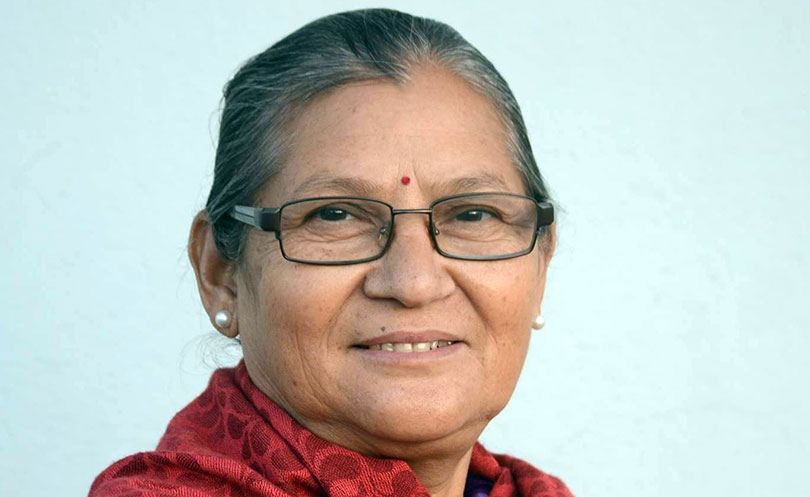
Ashta Laxmi Shakya
Brief Overview of Her Political Journey:
Looking at her family background, Ashta Laxmi Shakya was not someone who was expected to engage in left wing politics or dedicate herself to alleviating the suffering of the poor. She was born into a well-off Shakya merchant family in Jhochhen, Kathmandu (now Ward No. 23 of Kathmandu Metropolitan City), where her family had gold, silver, and handicraft businesses. She was born in October 1953 and was the second among eight children. There were no members in her family with a leftist political background.
Despite this, at the early age of 20, she became actively involved in movements advocating democracy, equality, and women’s liberation. Until her school years, she had a shy nature like other young girls. After passing the SLC examination, she went with her friend Sulochana Manandhar to learn the Chinese language. Their teacher, Dr. Mahesh Man Shrestha, not only taught them the language but also shared stories of the Chinese Revolution. Gradually, these experiences began to draw them toward leftist politics.
Around that time, her marriage had already been arranged. However, she informed her prospective groom that she would not be able to go through with the marriage and then left home. After coming into contact with the then CPN (ML), she handed over the jewelry she had brought with her to the party. The party assigned her to Piskar village in Kavre. She remained underground for 11 years. During this period, she got married to then UML leader Amrit Bohora.
Challenges Faced by Women in Contesting Elections:
After the restoration of open politics in 1990 (2046 B.S.), she contested elections and won. However, she believes that women have been held back due to the lack of fair competition in elections and the absence of a political mindset that prioritizes women’s electoral success during ticket distribution.
She further argues that the electoral system should be more women-friendly, and that political parties should develop a practice of selecting candidates based on genuine public support. She also suggests the need to improve the electoral environment by eliminating unhealthy practices in the election process.
Key Areas to Focus on for Women in Politics:
In a multiparty system, political parties are central; therefore, a women-friendly environment must first be developed within parties. There should be a mandatory provision in the party statute ensuring 33 percent women’s participation, and women must have meaningful representation from the ward, settlement, and village levels up to policy-making and law-making bodies.
Women should be granted organized party membership with more flexible criteria. Women should also be assigned geographical responsibilities to engage directly with communities. The need to keep women active within party structures through continuous capacity development is important. Women should be trusted with leadership roles, including positions as heads of party departments. Based on qualifications, skills, and experience, women should be included in mass organizations and involved in development and construction activities, ensuring their meaningful participation.
Key Characteristics of Women Political Leaders:
Women political leaders should develop a mindset of working for society and the nation through active engagement with the community. They should possess the ability to collaborate, make independent decisions, and have knowledge of various issues. Curiosity, a willingness to learn, study, and engage in discussion are also essential qualities. She stresses that women are not only participants but also leaders and therefore must develop all these attributes.
Advise for Young Women Political Leaders:
Young women political leaders should have the motivation to deeply study political backgrounds and history. They should be able to practice politics with sacrifice, dedication, and honesty rather than focusing on short-term gains. Along with a service-oriented attitude, they should develop the ability to work effectively even in small committees and strengthen their capacity for cooperation. Integrity and commitment in politics are equally important.
Role of the Party’s Women’s Association in Increasing Women’s Political Representation:
The Women’s Association is an important platform for women who aspire to enter politics. It has made a significant contribution to initiating women’s political journeys. Making this organization more effective is a way of strengthening women’s political participation.
Kunti Kumari Shahi
Political Journey of Kunti Kumari Shahi:
Kunti Kumari Shahi came into politics from a left wing background. Her entire family was associated with leftist politics. Her father, Bhakta Bahadur Shahi, used to win elections as a people’s candidate for the District Panchayat Committee Chairperson in Dailekh. Inspired by her family, she joined the then CPN (ML)-aligned student organization. At the age of 13 in 1990 (2046 B.S.), she became the district secretary of Akhil Panchau, affiliated with the ML. Because political discussions and meetings were frequently held at home, she was influenced by that environment. Since she was fully supported by her family to engage in politics, she began her political journey at an early age. After the political change of 1990 (2046 B.S.), leaders of the former Panchayat system formed the Rastriya Prajatantra Party. Gradually, her political inclination shifted from the ML towards RPP, and in 1991 (2048 B.S.), she joined RPP and took responsibility in its student wing. After joining RPP, her political career progressed further. When the party split, she joined RPP Nepal led by Kamal Thapa. In 2005 (2061 B.S.), she became the president of its women’s wing, Nepal Women’s Organization, and in 2009 (2066 B.S.), she was elected as a central committee member of the party. In the first Constituent Assembly election, she became a proportional representation member of parliament from RPP Nepal, and she continues to serve as a proportional representative MP from the same party.
Challenges Faced by Women in Contesting Elections:
Although elections are a key feature of democracy, Kunti believes that contesting elections is not easy for women. The foremost barrier is the lack of trust in women’s leadership within political parties as well as in society, which itself becomes the first obstacle. Elections have become financially demanding. Due to limited economic independence and lack of property ownership in women’s names, this creates an additional challenge. During election campaigning, candidates are required to travel anywhere at any time, which can also be difficult for women due to their physical circumstances. Furthermore, many women do not receive adequate family support when contesting elections. Limited access to education is also another major challenge for women in electoral participation.
Areas to Focus on for Women in Politics:
Political parties should include provisions in their statutes to reserve seats for women. Quotas for women should also be established in all party bodies. She further suggests that any committee without at least 33 percent women representation should not be granted legitimacy by the party. She also emphasizes that women should be given priority in key positions during appointments to constitutional bodies and in local government elections, as this would help advance women’s political participation.
Characteristics of Women Political Leaders:
Active participation in politics requires certain essential qualities. Women political leaders should have the ability to engage with diverse groups, a broad outlook, courage to speak out against injustice, hard work, self-confidence, fearlessness, a resilient and struggle-oriented nature, and the ability to prioritize society over personal interests.
Advice for Young Women Political Leaders:
She emphasizes that politics requires continuity and long-term commitment. Young women leaders should not only focus on themselves but also work to guide society and the nation. Since politics is the overarching policy framework for all sectors, it is essential to understand it in depth.
Role of the Party’s Women’s Association in Increasing Women’s Political Representation:
Women enter mainstream party politics through the Women’s Association, making its role very significant. When the number and participation of women in politics increase, it is largely due to the efforts of such associations. They play an important role in providing training, raising awareness, and nurturing talent. Even when party-level support is limited, women’s associations continue to carry out these activities independently.
Recent Posts
2nd Phase Citizen Journalist Training
Feminist Leadership Development Training