
Pushpa Bhusal
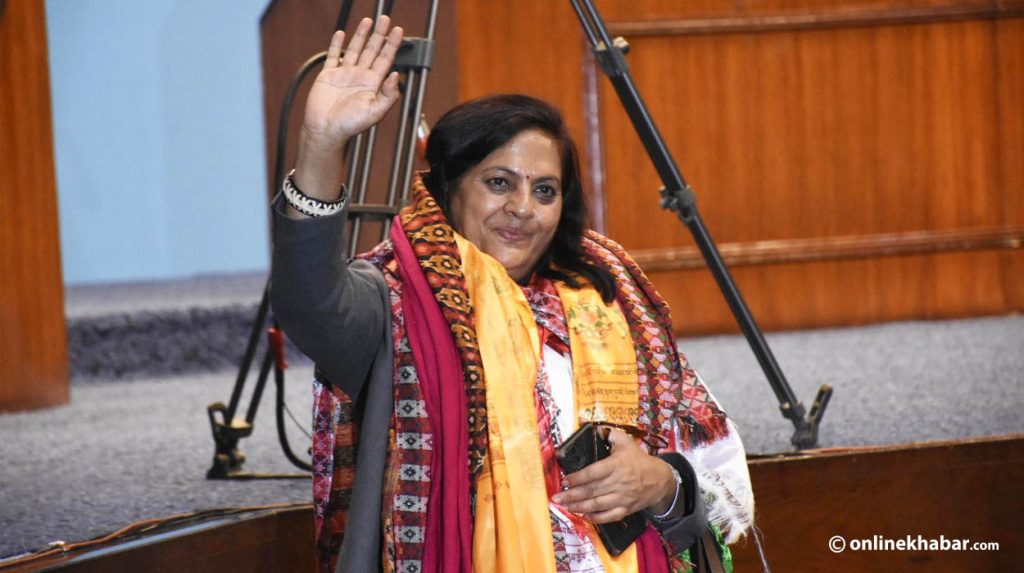
Political Journey of Pushma Bhusal
In 1959 (2016 B.S.), under the leadership of then Prime Minister B.P. Koirala, Pushpa Bhusal’s father, Kashinath Gautam, served as the Minister for Health and Local Self-Governance in the Nepali Congress government. In 1960 (2017 B.S.), after King Mahendra dissolved the Koirala government and took power, many Congress leaders were either imprisoned or exiled to India. Gautam, who had been a minister in that government, was also exiled to India along with his family.
During their 13 years of exile in India, the family faced significant hardships. They endured not only poverty but also constant security threats. Despite these challenges, Pushpa remained hopeful that political change would one day come to the country, bringing a better future for both herself and the nation. Gradually, this belief drew her closer to the Nepali Congress party.
After returning to Nepal, she studied law in accordance with her father’s wishes. During this time, she became a member of the Nepali Congress-affiliated student union (Nepal Student Union). Later, building on her legal background, she advanced her political career by serving on the party’s Central Legal Advisory Committee and as a legal advisor to the Nepal Trade Union.
In 2006 (2063 B.S.), when the Interim Constitution was being drafted, she was also a member of the drafting committee. In the first Constituent Assembly election, she was one of only two women elected as members of parliament from the Nepali Congress.
Major Challenges Faced by Women in Contesting Elections:
Due to patriarchal mindsets, women’s leadership is often not accepted. Various forms of violence during elections, inducements, misuse of power, and limited access for women from the local to central levels are considered major challenges that women face during elections. Lack of sufficient support from the government and political parties for women candidates, as well as limited access to political power, are additional barriers. The lack of sensitivity among political parties and leaders toward the electoral system further creates difficulties for women to contest elections.
Prevailing social norms and values make it difficult for women to directly participate in elections. Unlike men, it is often not feasible for women to adopt the same social, political, and economic strategies required to win elections.
Key Areas to Focus on for Women in Politics:
Women’s active participation within political parties is crucial. Since party structures from the local to the central level form the backbone of elections, women need to be gradually established in higher positions starting from the initial committees. Women’s representation is essential at every level and in all decision-making bodies of the party. Likewise, party constitutions, policies, and regulations must be women-friendly, and it is also important to ensure electoral constituencies for women. Women’s participation is equally necessary in key institutions such as policy-making bodies, law reform processes, constitutional bodies, and planning commissions.
Key Qualities Required in Women Politicians:
Women in politics should possess leadership skills, the ability to guide society, discipline, and the capacity to listen deeply to others. At the same time, they should be confident and able to accept others’ leadership as well. It is important for women to practice supporting and accepting leadership from other women.
Suggestions for Young Women in Politics:
The absence of women in the mainstream power structure of the state has held both women and the state back. Therefore, young women should move forward with strong commitment to politics. Continuity and self-confidence are equally important, so maintaining enthusiasm is essential. Many young women participated in the Constituent Assembly elections; although some faced defeat, they should not be discouraged but instead take it as a learning experience and continue moving forward. Rather than focusing solely on becoming members of parliament or holding positions, they should work actively as agents of change for society and the people.
Role of the Party’s Women’s Wing in Increasing Women’s Representation in Politics:
The women’s wing serves as an entry point into party politics, so it needs to actively engage women in political processes and advocate for increased women’s participation. It should also carry out various social and political initiatives that support and empower women to take on greater roles in politics.
Name: Onsari Gharti
Date of Birth: 2034/07/28 (B.S.)
Place of Birth: Jajarkoṭ–1, Rolpa
Mother: Naumati Gharti Magar
Father: Prasad Gharti Magar
Education: SLC Passed (School Leaving Certificate)
Humans are essentially peace-loving beings. But why does this peace-loving creature engage in destruction? Why does it take up weapons? Perhaps a brief biography of Onsari Gharti can help answer this.
Most women in politics often enter the field due to their family background. Many female leaders say they were drawn to politics because there was a political environment at home. However, Onsari Gharti’s family was not very closely connected to politics. Her elder brother was an ordinary communist activist. In 2041 B.S., after her brother was accused of killing and imprisoned, instability began in her family. To secure his release, the family sold all their jewelry and even had to take loans, yet it was not enough. A loan of 20,000 grew to 120,000, and even then, it was not fully repaid.
The family had seven children, three sons and four daughters. Their financial condition became so weak that it became impossible for her father, Prasad Gharti Magar, to afford the education of his children. Onsari, who witnessed the injustice done to her elder brother at a young age and endured the hardship that fell upon her family, had already been influenced by student politics through cultural programs run by local youth at that time. Despite her family’s difficult financial situation, she was determined to continue her education. Even by working late into the night doing household and farming tasks, she managed to cover her own study expenses.
While studying at the secondary level in Waling, Rolpa, she came into contact with the Communist Party. In 1991 (2048 BS), she was arrested and held in detention for one day. Shortly after her release, she went underground and became a full-time party member. She was initially involved with the Unity Centre and later joined the Maoists, eventually participating in the “People’s War” that began in 1996 (2052 BS).
She also took part in the Maoists’ first major action of the conflict—the attack on the Holeri police post in Rolpa on February 13, 1996. The group involved in the operation consisted predominantly of men, along with three women combatants, including her. During the operation, she was assigned a specific tactical role involving explosive devices. Following the successful attack and the seizure of weapons, the event quickly drew significant international attention, marking the beginning of broader global awareness of the conflict.
A few months before the start of the People’s War, on August 27, 1995, she married Maoist military leader Barshaman Pun (Ananta). During several phases of the conflict, she was pregnant while moving across operational fronts. In 1997 (2054 BS), she was seven months pregnant when the party planned an operation to capture the Pakhapani police post. While returning from a reconnaissance of the site, a betrayal by a party member led to their group being surrounded by police. To escape, everyone fled. She also tried to run but, due to her pregnancy, was unable to continue for long. She took shelter in a nearby bush but became disoriented, unsure of how to get out, with the risk of being captured if she emerged.
After the birth of her daughter, she continued to actively participate in party activities, often carrying her child on her back while working. She did not step away from her responsibilities on the grounds of postpartum recovery. Balancing political engagement with the responsibilities of single-handed childcare was highly demanding. For security reasons, she also carried a firearm at all times.
When her daughter was three months old, she expressed interest in participating in a planned military operation organized by the party. A fellow party member, who was also staying in the same shelter and had a similarly young child, offered to care for her daughter during her absence. However, due to the child’s age, the party did not approve her participation in the operation.
After her daughter turned two years old, she resumed full-time party responsibilities and was assigned leadership of the Eastern command. The first attack on the Holeri police post on the opening day of the People’s War was one of the most significant and memorable moments of her life. She considers her participation in this widely impactful military action a matter of great pride. However, she also regards the arrest of Lila Rokaya, the district vice-chairperson of the All Nepal Women’s Association (Revolutionary), by the police from her home, followed by her sexual violence and killing, as one of the most tragic moments of the conflict. During the People’s War, she carried out her activities under the name Comrade Usha.
In the prevailing revolutionary political context, she was deeply committed to the cause to the extent that her personal relationship with Comrade Ananta was also formalized into a marriage based on ideological principles.
The marriage between Comrade Usha and Comrade Ananta was based on three agreed principles:
- Both would continue to work as full-time party cadres even after marriage,
- The marital relationship would be subject to dissolution if their political ideologies diverged, and
- They would have only two children, regardless of gender.
Their lives continue to be guided by these three principles. They currently have one daughter and one son.
Following the peace agreement with the then government, the first election held afterward resulted in the Maoist party emerging as the largest political force in the country. Subsequently, in the government formed under the leadership of Maoist Chairperson Prachanda, she was appointed as the Minister for Youth and Sports. During the Constituent Assembly, she played an important role in the State Restructuring and Power Sharing Committee, representing the party’s position on ensuring the rights of historically marginalized communities, including Indigenous nationalities, Dalits, and women. She recalls that while some of the issues she advocated for were not fully realized, the majority were successfully incorporated and adopted in the process.
Being a woman herself, she frequently raised issues of women’s rights in Parliament. Among various forms of violence against women, she identified domestic violence as the most prevalent. Arguing that such forms of violence require a distinct approach, she also presented the concept of a “Women’s Court” before Parliament. She has highlighted that women still face challenges in politics due to limited inheritance and property rights, as well as the dominance of narrow thinking within political parties. According to her, political parties must ensure proportional representation of women at all levels and in all structures.
She emphasized that women in politics should possess not only self-confidence but also strong determination, courage, and a clear sense of goals and purpose to advance effectively in their political journey.
The first Constituent Assembly was dissolved without Promulgating a constitution. In the second election, the Maoist party was reduced to the third position. Despite this setback, the party recognized her contributions and elected her as the Vice-Chairperson of the Constituent Assembly. In the first Constituent Assembly, the same position was previously held by fellow Maoist leader Purna Kumari Subedi. Although the election results reduced the party’s representation, she remained confident that a constitution incorporating identity-based federalism would ultimately be promulgated.
Recent Posts
Feminist Leadership Development Training
Feminist Advocacy Training